 Networking +
 Policy +
 Member
 Career
 Choose
2026 Colorado Legislative Session Wrap-Up
Colorado’s 2026 legislative session, the Second Regular Session of the 75th General Assembly, concluded on May 13, the 120th day of session.
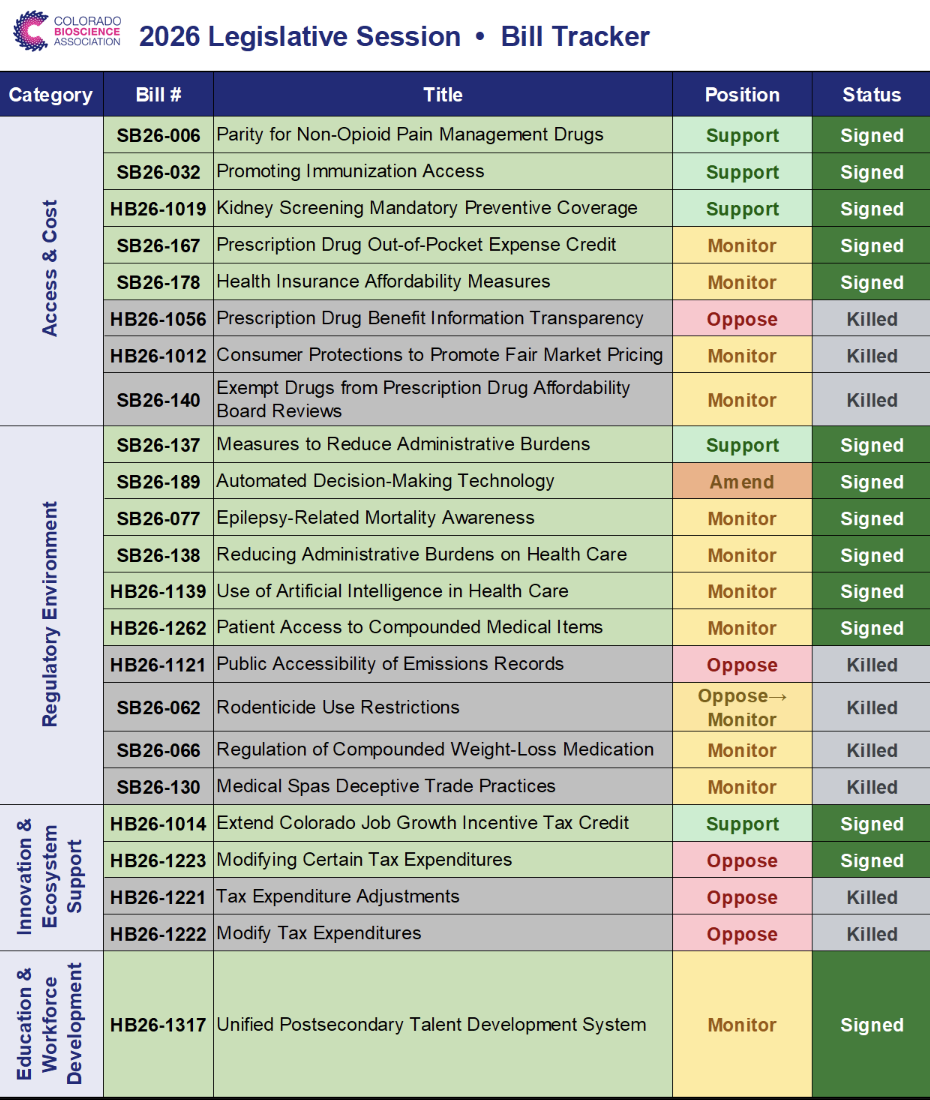
Of the 626 bills introduced by the General Assembly, Colorado BioScience Association (CBSA) took positions on 23 bills aligned to CBSA’s Policy Priorities, reflecting the needs of Colorado’s life sciences innovators and the patients they serve. Tracked legislation included bills focused on ensuring a balanced and reasonable regulatory environment, responsibly and effectively improving healthcare access and affordability, advancing innovation and economic development, and supporting education and workforce development.
CBSA ultimately supported five bills, opposed five bills, took an “amend” position on one bill, and monitored 12 bills. Fourteen of the 23 bills CBSA tracked passed the General Assembly and have been signed into law. The remaining nine bills failed during the legislative process.
The 2026 session unfolded against a challenging fiscal backdrop, with lawmakers navigating budget constraints, healthcare affordability issues, artificial intelligence policy, and continued questions about Colorado’s regulatory climate. Still, the session was described by some Capitol observers as a more collaborative year for businesses, with several major business and innovation issues resolved through bipartisan compromise.
The legislature passed a bill strengthening the state’s review of existing regulations, extended Colorado’s Job Growth Incentive Tax Credit, reformed Colorado’s 2024 artificial intelligence law, rejected two bills that would have rolled back approximately $450 million in business tax benefits, and considered a host of other bills affecting Colorado’s life sciences ecosystem. Governor Jared Polis signed SB26-137, the regulatory review bill, and SB26-189, the AI reform bill, shortly after the legislature adjourned, framing the bills as part of a critical effort to make Colorado an easier place to do business while maintaining appropriate protections.
Policy + Advocacy is an essential pillar of CBSA’s commitment to create co-opportunity for Colorado’s life sciences community and central to the value CBSA delivers to members and sponsors. The Policy + Advocacy team works year-round to advocate for a pro-business environment for health innovation, with strategic oversight provided by CBSA President & CEO, Elyse Blazevich.
Key Wins for the Colorado Life Sciences Ecosystem
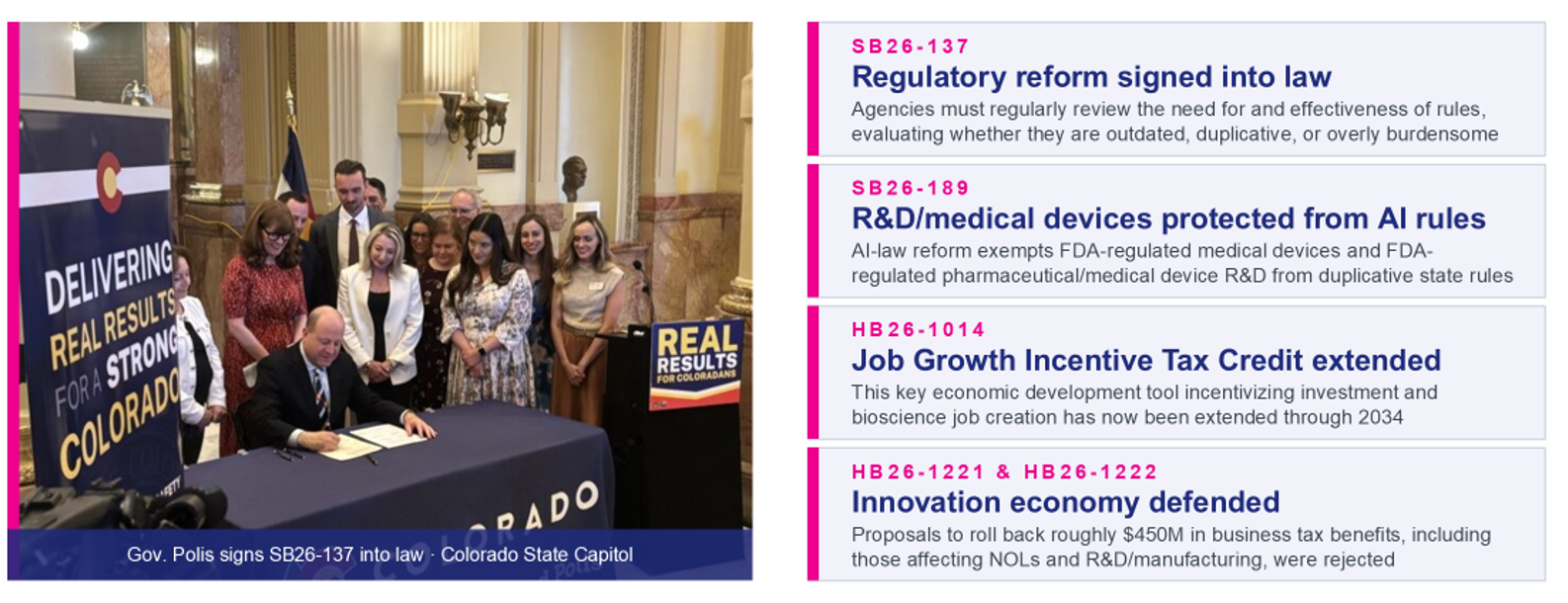 CBSA entered the 2026 legislative session focused on protecting Colorado’s life sciences ecosystem, improving the state’s regulatory climate, and ensuring that healthcare, technology, and economic development policy remained workable for innovators. CBSA was able to help secure several meaningful policy wins for Colorado’s life sciences community, including passage of SB26-137 aimed at reducing regulatory burdens for businesses, key exemption language in SB26-189’s AI regulatory framework, extension of the Job Growth Incentive Tax Credit, and the defeat of proposals that could have harmed Colorado’s innovation economy.
CBSA Leadership on SB26-137: Measures to Reduce Administrative Burdens
Among CBSA’s clearest advocacy successes was its work in support of SB26-137, Measures to Reduce Administrative Burdens. SB26-137 was the Colorado Chamber of Commerce’s priority bipartisan regulatory relief legislation for 2026 and took a practical approach to reducing regulatory burdens by improving how state agencies review their existing regulations. The bill creates clearer standards for evaluating whether regulations are outdated, duplicative, or overly burdensome, and ensures agencies regularly review their rules and justify their continued need.
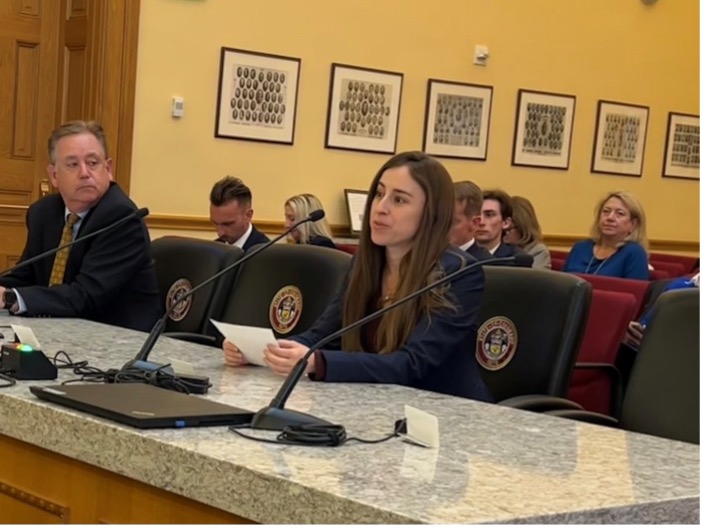
CBSA strongly supported SB26-137 because it advances a more predictable, efficient, and accountable regulatory environment for Colorado employers, including life sciences companies operating in a complex and highly regulated sector. Amy Berenbaum Goodman, CBSA’s Vice President and Counsel for Policy + Advocacy, testified in support of SB26-137 in both the House and Senate. In her testimony, she emphasized that, as a highly regulated industry with a long, capital-intensive development cycle before any revenue is generated, overly burdensome state regulations are especially damaging for the life sciences. After the bill passed the General Assembly, Governor Jared Polis signed the bill into law during his first post-session bill signing, emphasizing his excitement “to be lowering the cost of doing business in Colorado and streamlining regulation.” Amy Berenbaum Goodman joined Governor Polis, legislative leadership, and other business advocates for the bill signing. SB26-137’s enactment represents a meaningful step toward ensuring that state rules are regularly evaluated for duplication, effectiveness, continued need, and appropriate support.
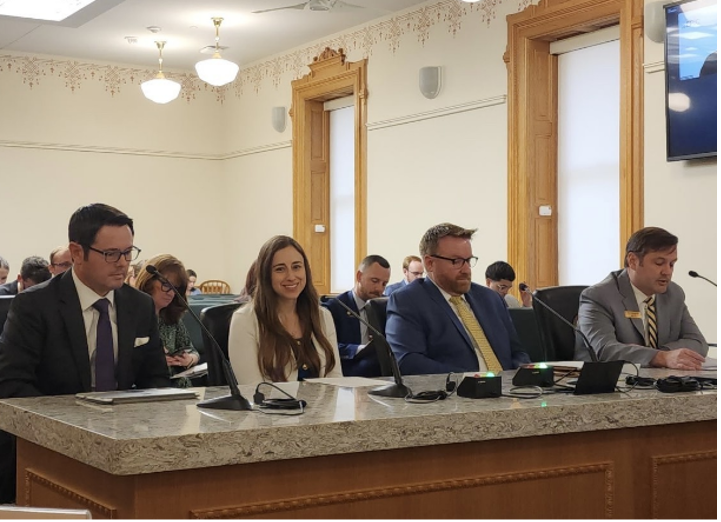
Advocacy to Exempt Medical Devices in SB26-189: Automated Decision-Making Technology
CBSA also secured an important policy outcome through its engagement on SB26-189, Automated Decision-Making Technology. The bill was introduced to reform Colorado’s precedent-setting 2024 artificial intelligence law and was one of the most anticipated bills of the year. CBSA was able to work with sponsors and proponents of the bill to ensure that SB26-189, upon introduction, included key language exempting medical devices subject to oversight by the U.S. Food & Drug Administration (FDA) or a pharmaceutical or medical device manufacturer’s R&D activities that are subject to oversight by the FDA, including clinical investigations conducted under 21 CFR 312. This exemption provides important protection for companies across Colorado’s life sciences ecosystem by helping ensure that companies developing FDA-regulated products are not subject to duplicative, conflicting, or overly burdensome state-level requirements layered on top of existing federal oversight. CBSA will be continuing to engage on this issue throughout the upcoming rulemaking process to try to ensure as much protection as possible for all companies across the life sciences community.
Support for HB26-1014: Extend Colorado Job Growth Incentive Tax Credit
CBSA also supported HB26-1014’s successful extension of Colorado’s Job Growth Incentive Tax Credit through 2034. The credit is an important economic development tool that helps Colorado compete for high-quality jobs and supports growth in innovation-driven sectors, including life sciences. Its extension helps preserve a key tool for attracting and retaining bioscience companies, investment, and talent in Colorado.
CBSA’s broader advocacy also reflected the association’s commitment to patient access, preventive care, and responsible healthcare policy. CBSA supported legislation improving access to immunizations, non-opioid pain management options, and preventive kidney screening, while continuing to monitor healthcare affordability, prescription drug access, and regulatory issues affecting innovators, employers, patients, and providers.
Work to Defend Colorado’s Innovation Ecosystem
At the same time, CBSA helped defend Colorado’s innovation ecosystem by opposing proposals that would have resulted in Colorado companies losing $450 million in tax breaks. Of particular note for life sciences companies, HB26-1221 targeted the net-operating-loss deduction that allows startups and other businesses that sustain losses to write part of those operating losses off in future years when they make a profit. In addition, HB26-1222 aimed to decouple state tax policy from recently expanded federal tax deductions speeding depreciation of manufacturing equipment, manufacturing facilities, and R&D expenses.
Throughout the 2026 legislative session, CBSA helped advance policies that support innovators and patients, secured targeted protections for federally regulated bioscience products, supported economic development tools that help Colorado compete, and advocated for a less burdensome regulatory environment. For CBSA members, these outcomes mean fewer unnecessary regulatory hurdles, better protection for life sciences innovation, continued support for job growth and investment, and a stronger voice for bioscience in Colorado policy debates.
Bill Summaries for CBSA’s Tracked Bills
The section below provides additional detail on each of the 23 bills CBSA tracked or engaged on during the 2026 session, including CBSA’s position, final outcome, and, for enacted bills, the date Governor Polis signed the bill.
Search bills by name on the Colorado General Assembly website.
Access & Cost
SB26-006 – Parity for Non-Opioid Pain Management Drugs
Sen. J. Amabile, Sen. B. Kirkmeyer; Rep. K. Brown, Rep. R. Taggart
Support | Became Law | Governor Polis signed on June 3, 2026
This law promotes access to non-opioid pain management drugs by addressing insurance coverage and cost-sharing parity. CBSA supported the bill as part of broader efforts to improve patient access to innovative treatment options and reduce barriers to appropriate care.
SB26-032 – Promoting Immunization Access
Sen. L. Daugherty, Sen. K. Mullica; Rep. K. Brown, Rep. L. Feret
Support | Became Law | Governor Polis signed on March 27, 2026
This law updates Colorado law related to vaccine access, including immunization coverage, pharmacist authority, school-entry vaccine provisions, and adult immunization protections. CBSA supported the bill because it promotes access to immunizations and supports preventive care and public health.
HB26-1019 – Kidney Screening Mandatory Preventive Coverage
Rep. S. Lieder, Rep. J. Bacon; Sen. D. Roberts, Sen. J. Rich
Support | Became Law | Governor Polis signed on May 26, 2026
This law requires health insurance coverage for preventive kidney function screening services. CBSA supported the bill because it expands access to early detection and preventive health services, helping patients identify and manage kidney disease sooner.
SB26-167 – Prescription Drug Out-of-Pocket Expense Credit
Sen. A. Benavidez, Sen. K. Mullica; Rep. A. Boesenecker, Rep. M. Lindsay
Monitor | Became Law | Governor Polis signed on June 3, 2026
This law concerns how certain prescription drug out-of-pocket expenses are credited for patients. CBSA monitored the bill because of its potential impact on patient affordability, prescription drug access, and health plan benefit design.
SB26-178 – Health Insurance Affordability Measures
Sen. K. Mullica, Sen. I. Jodeh; Rep. K. Brown, Rep. L. Gilchrist
Monitor | Became Law | Governor Polis signed on June 2, 2026
This law modifies Colorado’s health insurance affordability framework. CBSA monitored the bill because changes to insurance affordability programs can affect patients, employers, carriers, and the broader healthcare ecosystem.
HB26-1056 – Prescription Drug Benefit Information Transparency
Rep. K. DeGraaf
Oppose | Failed
This bill would have created the Prescription Drug Optimized Sourcing Transparency and Integrity Act, regulating certain statements made by pharmacy benefit managers and healthcare consultants about prescription drug sourcing programs. CBSA opposed the bill due to concerns about its potential impact on prescription drug access, safety, and the broader pharmaceutical supply chain.
HB26-1012 – Consumer Protections to Promote Fair Market Pricing
Rep. K. Brown, Rep. Y. Zokaie; Sen. W. Lindstedt, Sen. M. Weissman
Monitor | Failed
This bill would have added consumer disclosure requirements related to pricing for delivered goods. CBSA monitored the bill because of its broader consumer protection and pricing implications.
SB26-140 – Exempt Drugs from Prescription Drug Affordability Board Reviews
Sen. L. Frizell, Sen. J. Marchman; Rep. L. Gilchrist, Rep. D. Johnson
Monitor | Failed
This bill would have exempted certain prescription drugs from affordability reviews and upper payment limit authority under Colorado’s Prescription Drug Affordability Board. CBSA monitored the bill because of its direct connection to PDAB policy, patient access, and the innovation ecosystem. CBSA also continued to monitor PDAB activity during and after session, including board materials related to affordability reviews and upper payment limit considerations, because these policies can affect patient access, reimbursement, and the innovation ecosystem.
Regulatory Environment
SB26-137 – Measures to Reduce Administrative Burdens
Sen. J. Coleman, Sen. C. Simpson; Rep. J. McCluskie, Rep. J. Caldwell
Support | Became Law | Governor Polis signed on May 14, 2026
This bill requires state departments to review rules at least every five years and consider whether rules are duplicative, outdated, ineffective, or unsupported by appropriate funding. CBSA supported the bill because reducing unnecessary administrative burdens helps create a more predictable and efficient regulatory environment. CBSA’s support aligned with broader business community efforts to ensure state rules are reviewed regularly for duplication, cost-effectiveness, and continued need.
SB26-189 – Automated Decision-Making Technology
Sen. R. Rodriguez, Sen. J. Coleman; Rep. M. Duran, Rep. J. Bacon
Amend | Became Law | Governor Polis signed on May 14, 2026
This bill revises Colorado’s 2024 artificial intelligence law before its scheduled implementation, following extensive engagement from the business, technology, healthcare, and advocacy communities. CBSA took an “amend” position to help ensure the bill balanced consumer protections with workable requirements for innovators, employers, healthcare stakeholders, and companies using advanced technologies.
SB26-077 – Epilepsy-Related Mortality Awareness
Sen. I. Jodeh; Rep. L. Gilchrist, Rep. K. Stewart
Monitor | Became Law | Governor Polis signed on April 20, 2026
This bill requires death certification professionals to be aware of current recommendations related to epilepsy-related deaths and to identify epilepsy as a contributing or suspected cause when appropriate. CBSA monitored the bill because it relates to public health reporting and awareness.
SB26-138 – Reducing Administrative Burdens on Health Care
Sen. L. Daugherty, Sen. K. Mullica; Rep. K. Stewart
Monitor | Became Law | Governor Polis signed on June 2, 2026
This bill reduces certain administrative requirements in the healthcare system, including changes to provider continuing education requirements, health facility licensing timelines, patient screening processes, and hospital transparency reporting. CBSA monitored the bill because administrative burden in healthcare affects providers, patients, innovators, and the broader care delivery system.
HB26-1139 – Use of Artificial Intelligence in Health Care
Rep. J. Joseph, Rep. S. Lieder; Sen. L. Cutter, Sen. L. Daugherty
Monitor | Became Law | Governor Polis signed on June 2, 2026
This bill establishes requirements for the use of artificial intelligence systems in healthcare utilization review and prohibits payment for psychotherapy services provided directly by an AI system. CBSA monitored the bill because it implicates the responsible use of AI in healthcare, patient protections, and innovation in care delivery.
HB26-1262 – Patient Access to Compounded Medical Items
Rep. K. Stewart, Rep. R. Stewart; Sen. M. Ball, Sen. D. Roberts
Monitor | Became Law | Governor Polis signed on June 2, 2026
This bill preserves access to compounded drugs and devices when compounded in accordance with applicable state and federal law and limits the state board of pharmacy from adopting rules more restrictive than applicable law. CBSA monitored the bill because it relates to patient access, pharmacy regulation, and investigational or compounded medical products.
HB26-1121 – Public Accessibility of Emissions Records
Rep. L. García, Rep. B. Marshall; Sen. L. Cutter, Sen. C. Kipp
Oppose | Failed
This bill would have required owners and operators of certain stationary sources to make emissions records publicly available on their websites beginning in 2028. CBSA opposed the bill due to concerns about regulatory burden and the public disclosure of technical facility information.
SB26-062 – Rodenticide Use Restrictions
Sen. L. Cutter, Sen. C. Kipp; Rep. E. Velasco
Oppose à Monitor | Failed
This bill originally proposed broader restrictions on the sale and use of certain rodenticides and rodent glue traps. After amendments narrowed the bill to designate certain second-generation anticoagulant rodenticides as restricted-use pesticides, CBSA moved from opposition to monitoring.
SB26-066 – Regulation of Compounded Weight-Loss Medication
Sen. J. Carson, Sen. I. Jodeh; Rep. J. Jackson
Monitor | Failed
This bill would have regulated advertising and distribution practices for compounded weight-loss medications, including GLP-1 drugs that have not been approved by the FDA. CBSA monitored the bill because of its relationship to compounded medicines, patient safety, prescription drug access, and consumer protection enforcement.
SB26-130 – Medical Spas Deceptive Trade Practices
Sen. L. Frizell, Sen. C. Kipp; Rep. S. Lieder
Monitor | Failed
This bill addressed medical spas that use prescription drugs and would have established certain unfair or deceptive trade practices under the Colorado Consumer Protection Act. CBSA monitored the bill because of its potential implications for prescription drug use, provider practices, and patient safety in medical spa settings.
Innovation & Ecosystem Support
HB26-1014 – Extend Colorado Job Growth Incentive Tax Credit
Rep. R. Taggart, Rep. A. Boesenecker; Sen. L. Frizell, Sen. M. Ball
Support | Became Law | Governor Polis signed on May 29, 2026
This bill extends Colorado’s Job Growth Incentive Tax Credit through state income tax year 2034. CBSA supported the bill because the credit helps Colorado compete for high-quality jobs and supports economic development, including growth in the life sciences sector.
HB26-1223 – Modifying Certain Tax Expenditures
Rep. S. Woodrow, Rep. A. Boesenecker; Sen. M. Ball, Sen. D. Roberts
Oppose | Became Law | Governor Polis signed on June 4, 2026
This bill modifies certain tax expenditures and creates a new refundable tax credit tied to family income and children. CBSA opposed the bill because of concerns about the impact of tax expenditure changes on Colorado’s innovation and economic development tools.
HB26-1221 – Tax Expenditure Adjustments
Rep. E. Sirota, Rep. Y. Zokaie; Sen. J. Amabile, Sen. K. Wallace
Oppose | Failed
This bill would have adjusted existing tax expenditures. CBSA opposed the bill because of concerns that reducing or restructuring tax incentives could weaken tools that help support investment, company formation, research and development, and job growth in Colorado’s innovation economy. The bill was part of a package that would have rolled back significant business tax benefits.
HB26-1222 – Modify Tax Expenditures
Rep. L. García, Rep. K. McCormick; Sen. C. Kipp
Oppose | Failed
This bill would have modified certain tax expenditures. CBSA opposed the bill because of concerns about potential impacts on Colorado’s economic development and innovation-supporting tax policies. The bill was part of a package that would have rolled back significant business tax benefits.
Education & Workforce Development
HB26-1317 – Unified Postsecondary Talent Development System
Rep. J. McCluskie, Rep. R. Taggart; Sen. J. Bridges, Sen. L. Frizell
Monitor | Became Law | Governor Polis signed on May 28, 2026
This bill creates a committee to develop a plan for a unified postsecondary talent development system and the transition of workforce development program oversight to the Department of Higher Education. CBSA monitored the bill because a coordinated talent development system could strengthen Colorado’s workforce pipeline, including for high-growth industries like life sciences.